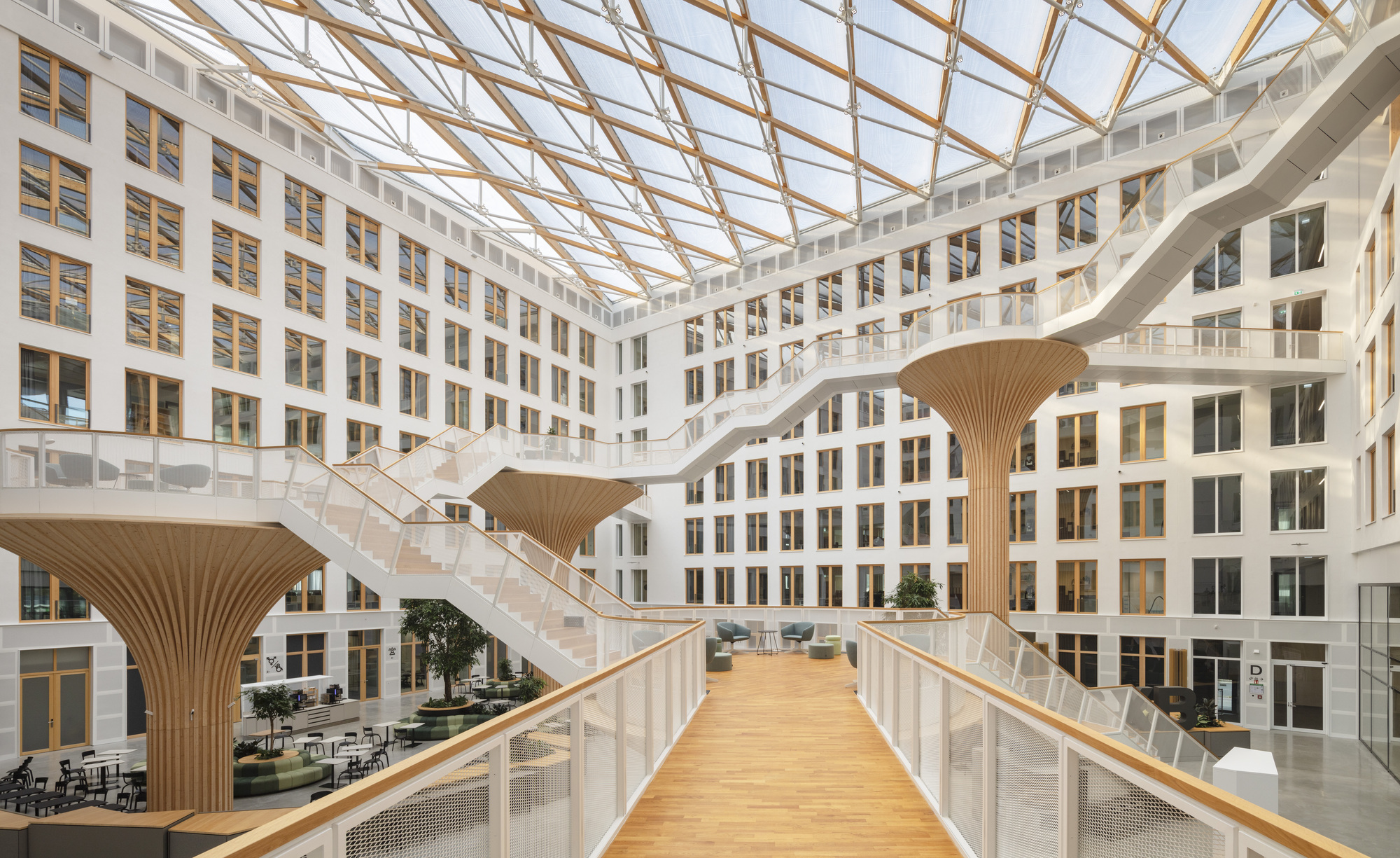
Paul Richardson, principal structural engineer in Buro Happold’s Boston office, explores the current trends in mass timber, and looks towards the future at what’s possible.
The rise of mass timber buildings has been intrinsically linked to the climate change agenda. As net zero targets get closer, and sustainability continues to rise up the agenda, it has become increasingly important for the built environment to reduce embodied carbon costs and use more sustainable building materials. With its eco-friendly credentials, design versatility, and aesthetic appeal, many developers across the world are increasingly turning to timber to help decarbonise large and complex projects.
In Europe for instance, carbon regulations and the EU taxonomy have increased the viability of timber projects. Meanwhile, in the United States of America, initiatives such as SE2050 and MEP2040 are driving the transition towards sustainable construction practices.
To meet these sustainability challenges, many more timber projects are coming forward, and no longer just for schools and residential buildings, but also for offices and other commercial spaces.
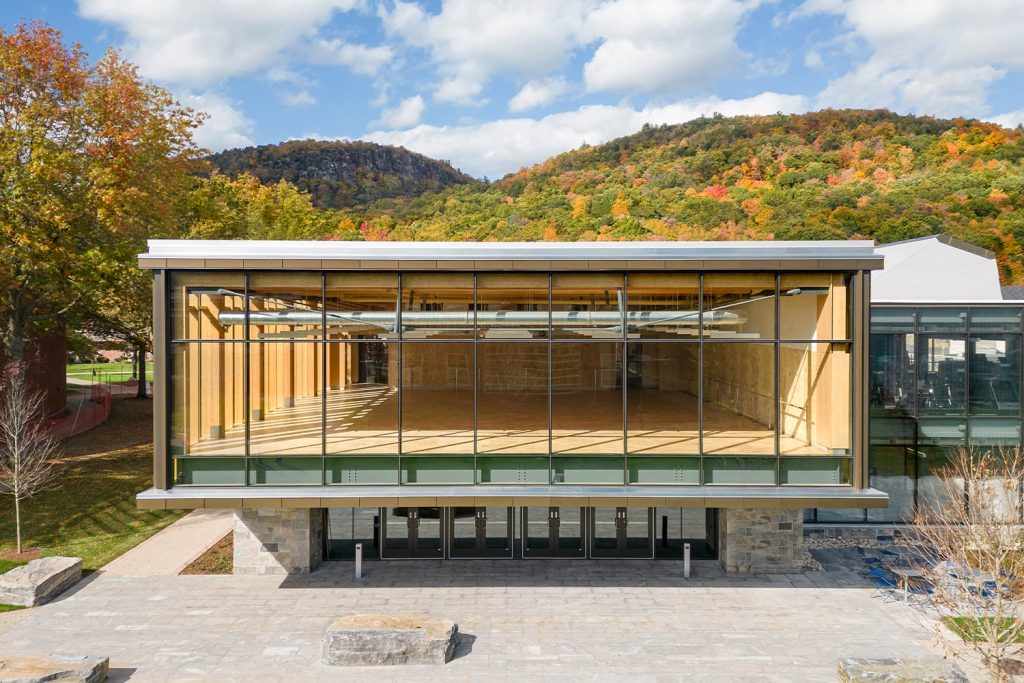
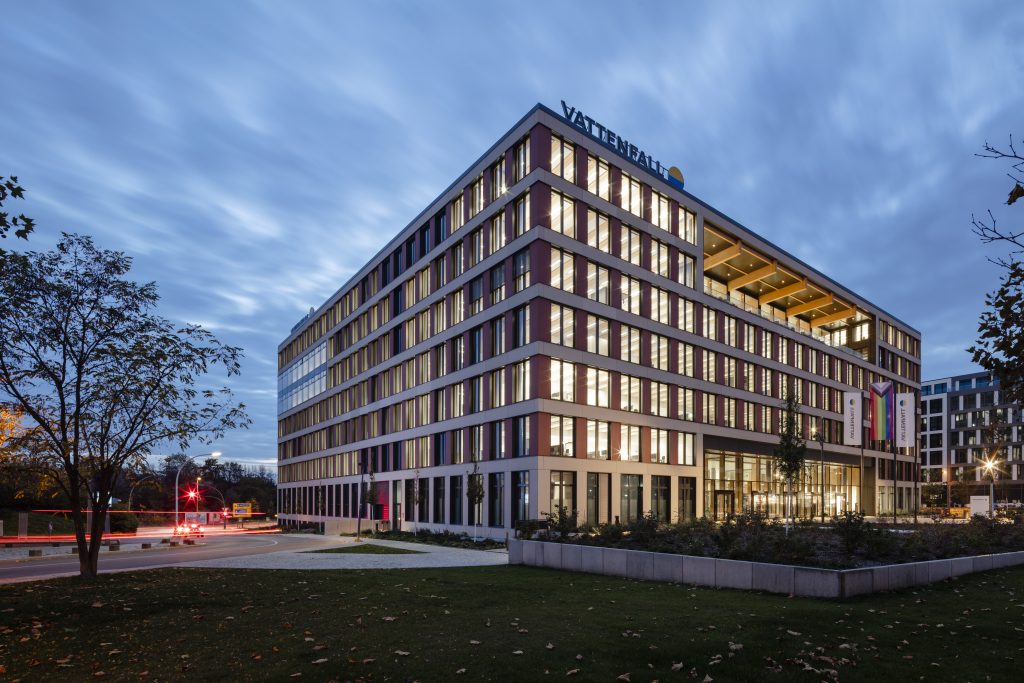
Buro Happold has been at the forefront of this work, involved in headline projects across the globe from Germany and Hong Kong to the Antarctic. This includes EDGE Südkereuz in Berlin, the Henryk Arctowski Polish Antarctic Station, Connecticut’s Quinnipiac University Recreation and Wellness Center, Canopy Gulbenkian Garden in Lisbon, Portugal, and the Weald and Downland Gridshell in West Sussex, UK.
What are the benefits of timber?
There are clear benefits to timber construction. The reduction of embodied carbon is the most significant, but there are also opportunities to save time during construction. Being a lightweight material as well, timber adds little load to existing structures and the elements are easy to handle on site.
With all these advantages, there’s huge potential to further develop the use of timber, especially timber-hybrid systems which use timber in combination with steel and/or concrete .
With a hybrid solution, the advantages of each material can be maximised. Hence, the same capacity, fire protection and acoustic requirements can be achieved with an optimised cross section using less material.
However, this does in turn require decisions to be made earlier on in the design process. A shift in the planning process is needed, with more detailed plans created at an earlier stage with greater consideration of the construction process.
This is where computational tools become pivotal. A fully integrated, interactive BIM model is therefore indispensable. At Buro Happold, we’re currently working on a rapid prototyping tool to optimise the planning process with modular hybrid systems. Ultimately, the benefits lie in the reduction of on-site errors (which decreases waste), financial risk and embodied carbon.
Reaching new heights
Across all construction sectors we’ve seen another trend emerge, as many more developers are coming forward with plans to build taller with timber.
In the US market, the IBC 2021 code update – which permits the construction of mass timber buildings up to 18 stories – has been a catalyst for building taller. In short, it allows mass timber to compete with steel and concrete.
However, this trend hasn’t just been driven by changes to planning regulations. Timber also has qualities that make it suited to high-rise developments. For instance, it’s a lightweight material. The less weight a structure has, foundations can be. We also see lower the material consumption and carbon emissions.
Timber also has a high potential for prefabrication and mass fabrication, which can make building a taller structure much more efficient and quicker to construct.
Looking to the future
One of the big trends we expect to see going forward is a wider application of timber for different types of buildings. Mass timber is already widely applied for schools and residential buildings, but for offices and other commercial buildings, there are fewer examples – until now. However, the demand is massively increasing as we reduce emissions to reach the 1.5°C goal under The Paris Agreement, and as more countries adopt carbon regulations.
We’re also expecting to see the market for mass timber evolve. Right now, there are many more projects coming forward in Europe and America. This concentration reflects where the mass timber industry is most mature, and where the industry is most familiar with using it as a construction material.
We expect this to change, and are already seeing more projects using mass timber outside of these regions. And with codes changing, new manufacturing plants opening and local initiatives to encourage the reduction of embodied carbon, we are going to see the increasing use of mass timber outside of these usual geographical locations.
As we look towards increasingly pressing climate targets, the message to clients, developers and architects is clear. With the right expertise and a suitable project, there are serious embodied carbon savings to be made with timber, a great tool to help us all meet the sustainability challenge.